Guide
Glamping Domes Explained: How They Are Built and How They Behave

A glamping dome looks like a piece of architecture and sleeps like a night in a tent. How one feels at 3 a.m. comes down to how it was built and what the host added.
What a glamping dome is
The word “geodesic” describes a hemisphere made from a lattice of rigid triangles. A triangle holds its shape under pressure, where a square will lean, so a load pressed on one point gets passed along to its neighbors and spread across the whole shell. That is why a dome can be light and still carry weight for its size.
The idea has a longer history than most guests expect. Walther Bauersfeld, chief engineer at Carl Zeiss in Jena, designed an early geodesic dome after World War I to house a planetarium projector. R. Buckminster Fuller popularized the form and received a U.S. patent for it, number 2,682,235, dated June 29, 1954. A glamping dome is that same triangulated shape, scaled down to a bedroom with a stove or a heat pump and a king bed.
The frame
Most glamping domes sold to hosts use a galvanized steel frame. One UK manufacturer lists its 6 meter model (about 20 feet across) as steel poles 26 mm in diameter with a 1.5 mm wall, joined at hot-dip galvanized connectors, for a total shipping weight of 450 kg. Galvanizing is a zinc coating that resists rust. These frames stay outside for years.
The poles are short. They bolt or slot together into triangles that then join into the dome. Because the pieces are small, a crew can assemble a dome without a crane. The frame is a kit with no poured foundation. The same maker describes pegging the dome into grass with steel pegs or bolting it to a deck, and adds that a heavy modular floor improves stability in extreme weather.

The cover
Stretched over the frame is a fabric skin, and in most commercial domes it is PVC. Makers list PVC-coated nylon or polyester at roughly 650 to 900 grams per square meter, and some offer higher-end coatings such as PVDF at up to 1,100 grams. The coating is what makes the fabric waterproof, UV-resistant, and in many listings flame-retardant (one UK maker cites a B1 fire rating).
Many domes also include a clear panel, either a large front window or a clear sidewall. The pictures of stars and sunrises come from there. Clear PVC is thin. It lets in daylight and lets heat pass both ways.
Fabric wears out. One manufacturer claims a frame lifespan of 15 years and a PVC lifespan of 8 years on a pro-rated basis. Those are a seller’s figures. They do show that the skin is a replaceable part, so a well-run dome has its cover checked and swapped on a schedule.
Heating and cooling
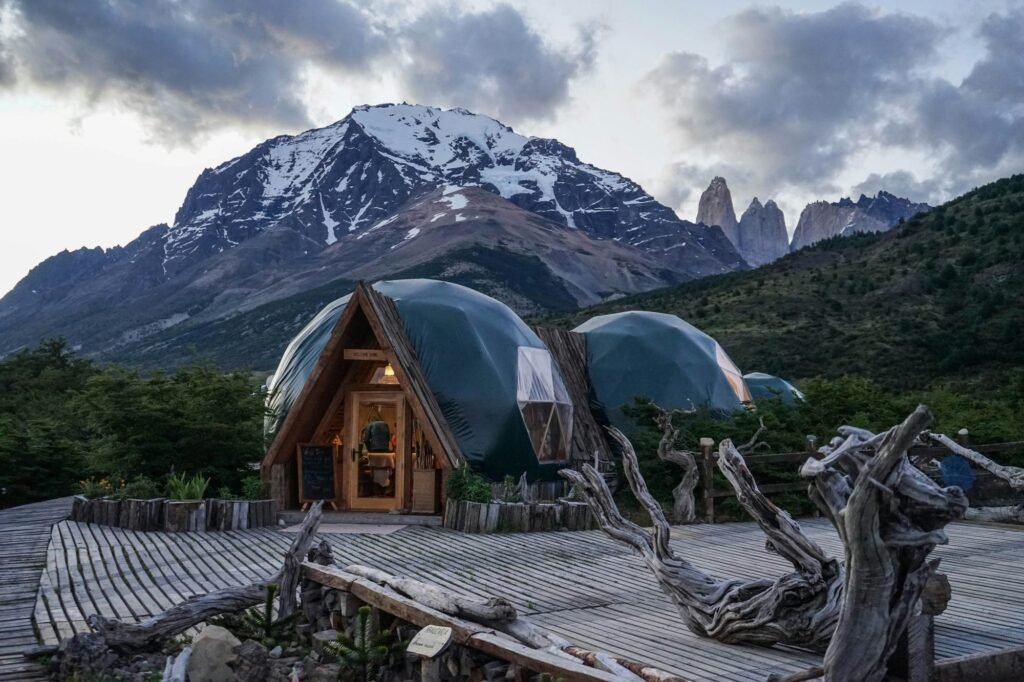
Here is the part a listing photo cannot show. Most domes are lightly insulated or not insulated at all. As nice as they look, they are still giant tents. A thin fabric skin has very little thermal mass, so the air inside follows the weather outside more closely than it does in a cabin with walls and a roof deck.
Think of a parked car on a July afternoon. The shell is thin, the sun hits it, and the inside warms up fast. A dome in direct summer sun behaves the same way, and in winter it loses heat just as quickly once the stove or heater is off.
Manufacturers do offer fixes. One UK maker describes a 5 cm padded polyester insulation layer, but its own specification table lists insulation as an optional extra. Makers also sell roll-up windows, peak vents, a solar-powered exhaust fan to pull hot air out, a stove with a vent pipe through the fabric, and in some cases air conditioning or a mini-split heat pump. One supplier advises matching insulation thickness to the local climate and pairing it with a fan for hot places.
Comfort depends on what the host installed. A dome with an insulated liner, a mini-split, and good vents can be comfortable year-round. A dome with a portable heater and a single window may be pleasant in May and rough in January. A booking page seldom says which one you are getting, so you have to ask.
Condensation is another tent trait. When the outside air cools overnight, moisture can collect on the inside of the cover. Vendors’ answer is airflow: peak vents, mesh openings, and a bit of fresh air coming in as warm, damp air goes out.
Wind, snow, and rain
Manufacturers rate their domes for wind. One UK maker lists 100 km/h wind loading for its 6 meter dome, and another supplier quotes 80 to 120 km/h on a 0.5 kN/m2 basis. Consumer garden domes sold for patios are rated far lower, around 50 km/h in one listing, so a rating in a marketing page says little about the weather a particular site can take.
Those figures are the sellers’ own. The units differ from one maker to the next (kilometers per hour, kilonewtons per square meter), the test standards are seldom named, and snow ratings are often missing. One maker’s 6 meter dome page gives no snow figure at all. That is why a guest, and a host, should treat the numbers as a starting point and look at how the dome is anchored and how the site is exposed.
A dome has many panels and connection points, and the cover keeps water out only if the seams and the base are well sealed. Heavy rain on fabric is loud, like popcorn on a tin lid, and some guests love the sound while others lie awake. If a forecast shows storms, it is fair to ask where the bathroom is and how far the walk is in the wet.
Questions to ask a host before you book
If you are traveling in the heat of summer or the cold of winter, ask about interior temperature before you pay. The answer will tell you more than the photos.
- How is the dome heated and cooled, and is the system on a thermostat or manual?
- Is the cover insulated, or is it a single layer of fabric?
- What is the usual inside temperature on the hottest and coldest nights of this month?
- Is there air conditioning or a heat pump, or only a fan or a space heater?
- Does the heater run safely all night, and is there a smoke and carbon monoxide alarm?
- Is the bathroom inside the dome or a walk away, and is the path lit?
- How loud is rain or wind on the cover, and are earplugs provided?
- What happens if severe weather arrives during my stay?
The answers do not need to be perfect. A dome with a fan and a patio heater can be a fine stay for the right month. The goal is to book the version of the dome you are going to get.
A dome with a tub outside raises its own questions about the water, covered in glamping with a hot tub. For another small stay with its own build rules, see tiny house stays. Another round room under a fabric cover is the subject of the yurt rental guide.
Frequently Asked Questions
Are glamping domes warm in winter?
Only if the host added insulation and heat. Most domes are lightly insulated or not insulated at all, and they lose heat quickly once the stove or heater is off. A dome with an insulated liner, a mini-split, and good vents can be comfortable year-round.
Do glamping domes get hot in summer?
Yes. A dome in direct summer sun warms up fast. Makers sell roll-up windows, peak vents, solar-powered exhaust fans, and in some cases air conditioning or a mini-split heat pump.
What is a glamping dome made of?
Most use a galvanized steel frame under a PVC-coated fabric cover. Makers list the fabric at roughly 650 to 900 grams per square meter. Many domes also have a clear panel or a large front window.
How long does a glamping dome last?
One manufacturer claims a frame lifespan of 15 years and a PVC lifespan of 8 years on a pro-rated basis. Those are a seller’s figures. They show that the cover is a replaceable part.
Are glamping domes loud in the rain?
Yes. Heavy rain on fabric is loud, and some guests love the sound while others lie awake. If a forecast shows storms, ask where the bathroom is and how far the walk is in the wet.