Guide
Renting a Treehouse: How the Stay Is Built and What to Expect

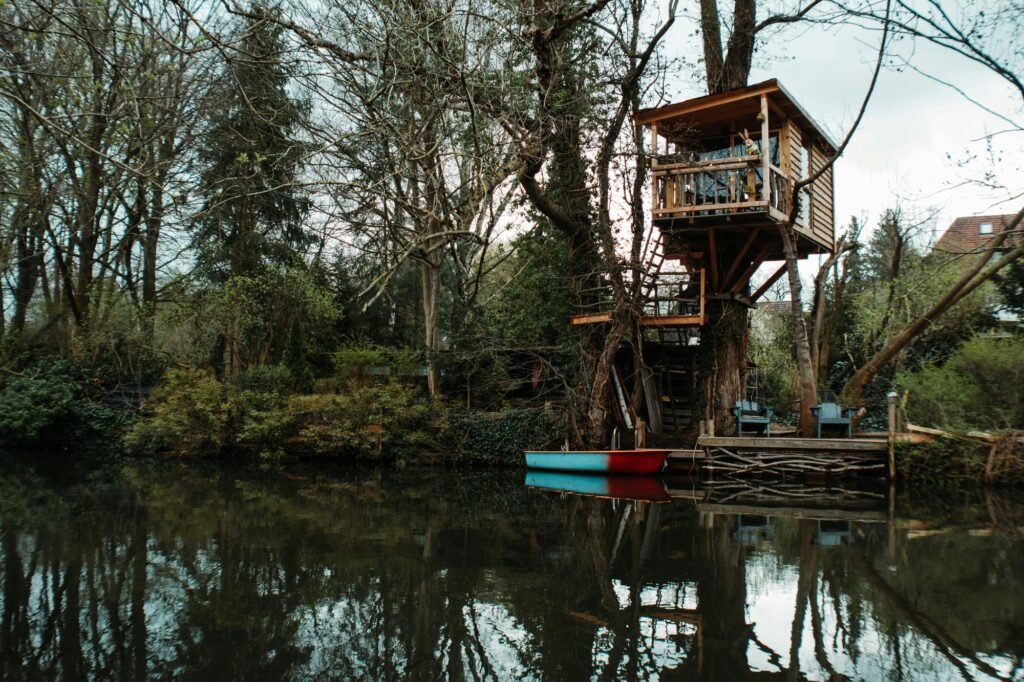
A treehouse rental is a building held up by living trees, by posts, or by a mix of both. The photos show the stairs, the deck, and the view. The tree is the part a guest cannot inspect from a booking page.
Support
Does the tree move? Yes, by design. A builders’ guide published online notes that trees are naturally flexible so they can bend in storms without snapping. The higher a treehouse is built, the more it moves with the tree.
That creates a problem when two trunks or branches carry one platform, because they will not sway in step. The guide says that locking them rigidly together lets storm forces build until bolts or beams break. Its answer is a floating joint: one end of a beam is fixed to a trunk, and the other rests in a bracket where it can slide as the trunks move. The main fixed joint goes on the largest trunk, the part of the tree that moves least, according to the same guide.
A sailboat mast is a fair comparison. The mast is built to bend, and the rigging around it has to allow for that.
Bolts and Tree Health
Do the bolts hurt the tree? A tree cannot heal a wound. Penn State Extension explains that a wounded tree walls off the damaged wood and gives up those cells to keep decay from spreading. Oak, hickory, and sugar maple are strong at this. Silver maple and cottonwood are weak at it and tend to go hollow in the center while adding new wood outside.
Every bolt hole is one of those wounds. The builders’ guide says nails and screws are not made to carry a real load and recommends bolts of three-quarters of an inch or more. It warns against setting them closer than 12 inches apart, where the tree may wall off the whole area and the wood between them can die. One supplier sells a treehouse attachment bolt, a timber bolt with a built-in shear collar. It says its smallest models have tested at 2,000 to 12,000 pounds each depending on the tree. The same supplier says North American species differ by about five to one in what they will bear, and that the smallest tree it has seen used is 10 inches across.
Who checks all of this? Hostaway, a vacation rental software company, advises hosts to work with a certified arborist and an experienced builder, to have each tree inspected for health every year, and to use attachment hardware that allows for growth. It also recommends a structural engineer with treehouse experience before building. Insurers, it says, will likely want proof of regular inspections. That is vendor advice. It also makes a fair list of questions to send a host.

Wind and Movement
Will it sway? On a treehouse built around a single trunk, the builders’ guide says, a small rocking at the trunk grows toward the edges of the platform and can reach several inches. No source gives a typical figure for rentals, so the host is the one to ask.
Two questions are worth sending before you book. Does the structure move in strong wind? Does the host close it when high gusts are forecast? Weather rules differ from host to host. The booking’s cancellation terms govern any refund. The Airbnb cancellation policy guide covers how those terms work.
Stairs and Access
How do you get in? Climbing up is the main physical fact of a treehouse stay. Pennsylvania’s state tourism office published a 2026 roundup of treehouse stays that shows the spread: one is perched 35 feet above the ground, one is more than a quarter mile from the road, and one is described as ADA accessible. Hostaway tells hosts to state the number of steps and the physical requirements in the listing and to post and enforce weight limits.
Ask for a step count and whether there are rails on both sides. One vendor’s safety guide puts the top rail at 36 inches and says that in most places no gap in a railing should be 4 inches or wider. For a very tall treehouse, it suggests the 42-inch height that residential code sets for balconies. Hostaway notes that treehouse building codes vary dramatically by jurisdiction and advises railings above the local minimum. The railing in the photos may be the best evidence you get, so look at it closely.
Airbnb defines a step-free path as one with no steps, stairs, or curbs from a guest’s arrival to the entrance, with thresholds under 2 inches. Guests who need that can ask the host for photos of the whole route from the parking area to the door.
Water, Power, and Heat
How does water get up a tree? Hostaway says water and electricity usually arrive through buried lines from the main property, with flexible connections that allow for the tree’s movement. It names composting toilets and solar power as popular alternatives. The Pennsylvania roundup shows how far heat sources range: a wood-burning stove in one treehouse, a gas fireplace in another, and heat with air conditioning in a third. One stay listed as a treehouse is a chalet-style cabin with a generator for electronics.
Hostaway notes that summer heat rises, so ventilation or cooling matters up high. It adds that leaf cover changes the view and the privacy between seasons, and that winter access can be hard depending on the climate. A bare-branch month brings a wider view and less screening from neighbors. Some treehouse decks carry a hot tub; glamping with a hot tub covers what to ask about those.
Booking Site Rules
A treehouse Airbnb search can start at Airbnb’s own page of US treehouse rentals. Some of the stays on it are domes or cabins, so read the listing as well as the label. Airbnb’s Help Center says hosts must disclose safety hazards inherent to a listing in the listing description, with “access to high heights, a pool, or a body of water” as its examples. If a host fails to disclose or address a known hazard, Airbnb says it may issue warnings, suspend or remove the listing, and cancel upcoming or active reservations.
Vrbo’s help pages are less specific. Its listing guidelines say content must accurately portray the rental, and its safety page advises hosts to mark tripping hazards, install smoke and carbon monoxide alarms, and follow regional safety laws. Neither page names heights as a hazard to disclose. On either site, read the safety section of a treehouse listing and treat a blank one as a reason to ask. How the two sites compare more broadly is in Airbnb or Vrbo.
Questions to Ask
The full set of questions for any host is in questions to ask an Airbnb host. For a treehouse rental, add these.
- How many steps lead to the entrance, and are there rails on both sides?
- What species is the tree, and when were the tree and the structure last inspected?
- Does the structure move in wind, and what is the weather policy?
- Where is the bathroom, and how far is the walk at night?
- What heats and cools the space?
- Is there a weight limit or a guest limit, and does it count children?
- Can luggage be carried up, or should it stay light?
Two other small stays have guides of their own: tiny house stays, from cottages on trailers to small cabins on foundations, and yurt rentals, round rooms of lattice and fabric.
Frequently Asked Questions
Do treehouse rentals move in the wind?
Yes, by design. Trees bend in storms, and the higher a treehouse is built, the more it moves. On a treehouse built around a single trunk, a builders’ guide says the rocking at the platform edges can reach several inches.
Do bolts hurt the tree a treehouse is built on?
Yes. A tree cannot heal a bolt hole and can only wall off the damaged wood. Penn State Extension names oak, hickory, and sugar maple as strong at this and silver maple and cottonwood as weak.
Are there accessible treehouse rentals?
Some are. Pennsylvania’s 2026 state tourism roundup includes one stay described as ADA accessible and another perched 35 feet above the ground. Ask the host for a step count and photos of the whole route from parking to the door.
How does a treehouse rental get water and power?
Usually through buried lines from the main property. Hostaway says those lines need flexible connections that allow for the tree’s movement. It names composting toilets and solar power as popular alternatives.
Does Airbnb require treehouse hosts to disclose safety hazards?
Yes. Airbnb’s Help Center says hosts must disclose safety hazards inherent to a listing in its description, with access to high heights among its examples. Vrbo’s help pages do not name heights as a hazard to disclose.